
Showing posts with label jean-pierre melville. Show all posts
Showing posts with label jean-pierre melville. Show all posts
22 October 2019
Two Men in Manhattan (1959)

16 April 2017
Frantz and François
I loved the new François Ozon film, Frantz. The movie stars Paula Beer and Pierre Niney and is mostly in black and white. It is a mystery of sorts. It takes place in Germany in 1919 after WWI and concerns a strange French mourner, Adrien, who has come to weep at the grave of Anna's dead fiancé.
 The mourner haltingly develops a relationship with Frantz's family and Frantz's fiancé. He was Frantz's friend in Paris, he tells them. But it is clear from the very beginning that Adrien is taking Frantz's death much harder than he ought to be taking it. We will find out what their real relationship was as the film continues, but Frantz is a film consisting of a series of parallels. Images, situations, languages are doubled in the film, ghosting each other. There is always another side to every situation in the film, there is a second ghost for every one we meet. Frantz is divided neatly in half by the revelation of Frantz and Adrien's real relationship midway through the film, and from there Ozon has more surprises in store.
Frantz, it should be noted, is not an action film. It is a slow, sad, romantic film that is more about the ghosts of World War I than it is about anything else. But Ozon is doing wonderful work, and his use of color in Frantz is absolutely astounding.
The rest of this post will have spoilers.


Frantz, it should be noted, is not an action film. It is a slow, sad, romantic film that is more about the ghosts of World War I than it is about anything else. But Ozon is doing wonderful work, and his use of color in Frantz is absolutely astounding.
The rest of this post will have spoilers.
* * * *
What I love about Frantz is the way everything in the movie is doubled. When we're first in Germany we feel sorry for Adrien and Hans Hoffmeister as they try to talk sense to the Germans who hate the French and spit at them. Their singing and nationalism seem scary but also ignorant and stupid. How easy it is to look down on the Germans, who, after all, would start the next war. But when Anna goes to Paris she encounters precisely the same thing. The train car attendant glares at her, the French woman with her children looks at Anna in disgust. And then in the bar all the patrons stand and sing "La Marsellaise". It's actually terrifying. And we are not in a tiny German town. This isn't a little burg somewhere: this is Paris.

The French and the Germans are doubled in Frantz, certainly, as Adrien is Frantz's double, but Ozon also doubles the dead for whom we are asked to mourn. Frantz himself, whom we grow to love, even as he fades more and more persistently from the film, but then when we meet Fanny, we find that her brother, too, was killed in the war, a boy even younger than Frantz who, of course, is named François. The film is insistent that we understand World War I not as a series of aggressions in which France and Germany fought one another but as a disaster that befell a generation of men because their fathers willed it so. What is France? What is Germany? the film asks, other than the happiness of its young people?
Ozon's use of color and black-and-white is, perhaps, Frantz's most striking feature. Ozon is a theatrical director, and it is here where his film betrays his flair for excess, but in Frantz this is understated and subtle, and Ozon uses it to such perfect effect. The work here is a kind of gorgeous tribute to Douglas Sirk, and Frantz is certainly a melodrama. The very first shot of the film is in color, even though it looks like it is in black-and-white. We see pale pink flowers as we look at the image of a nearby town in a gray morning sunshine. It is a trick of the light – the kind Melville pulls in Le Samouraï. Then we meet Anna and the film is firmly in black-and-white. But the film becomes a color film when the oppression of grief lifts momentarily. As Adrien first tells the Hoffmeisters about his trip to the Louvre with Frantz, we see the boys run and cavort in the palace, and the film soars in color as we watch them. We return to the present and return to black-and-white, of course, but the next time Adrien tells a story about Frantz we are again in color as Adrien lovingly moves Frantz's hands as he teaches him violin technique.

The first time the present day switches into color took everyone in the theatre by surprise. Anna and Adrien walk through a shadowy underpass and as they emerge, we are in color. The switch is so subtly done that the people next to me only figured it out forty seconds in, at which point they gasped. It's a gorgeous sequence of events, and Anna's happiness is made beautifully evident. We've been desperate for her happiness for most of the film and we hadn't realized it. After we have found out the truth and Adrien has gone back to France, Anna walks that same path on the way to commit suicide. The shots are doubled. She covers the same area alone, paces a field, crosses through the underpass, and when we didn't switch to color this time, I couldn't help but cry. It is all black-and-white for Anna.
There are more doublings in the film – the entirety of Frantz hinges on a kind of double story of possibility: what might have happened if the war hadn't existed, if Adrien hadn't killed Frantz, if Adrien hadn't been French and Anna German, or if those things didn't matter, if Adrien had married Anna instead of Fanny. These worlds exist in the film, though, because we are told about them; all of these worlds are described beautifully to the Hoffmeisters, who believe them. But the film plays with these fantasies and allows us to project our own desires onto these characters as well. I will confess that I hoped that Frantz and Adrien had been lovers. This mysterious, beautiful man, who wept so easily, so copiously while talking about Frantz. Surely, I thought, their relationship had been sexual. In the fantasies Adrien spins for the Hoffmeisters, the first painting we see in the Louvre appears to be one of Sebastian, that patron saint of queer men. In these beautiful, colorful fantasies, Adrien looks at Frantz with such absolute love that it is heartbreaking, and after he kills him, he lays on top of the other man like a lover, caressing his face.
 |
| Le Suicide |
Ozon plays with these fantasies, and we project them continually. I came to feel that our projections were the very purpose of Frantz, who is, after all a projection himself.
Adrien finally kisses Anna and it seems that, perhaps, the two might make a life together. My heart followed that fantasy, hoping it could be possible. No, Anna says, it is too late. But then she writes to the Hoffmeisters precisely the opposite. She has met Adrien in Paris, she says, and he is playing with the Orchestre de Paris, and she is accompanying him on the piano. We know it isn't true. Or do we? At the film's end, Anna returns to the Louvre; she walks toward the two Manet paintings on the wall, the Dejeuner sur l'Herbe and Le Suicide, and we see the back of a young man's head. It is Adrien, we think! They are together again. He has left Fanny, and she is meeting him at the Louvre. All will be well. It is not him, of course, and what becomes clear to me is that it is I who am living in the fantasy world, here. It is I who wish for reality not to matter, hoping the pair can find each other, dreaming that out of the pain of the war something beautiful can be created.
 |
| Dejeuner sur l'Herbe (Le Bain) |
One last double. Above the Manet painting with which Frantz ends is another, more famous Manet canvas, the Dejeuner sur l'Herbe. This is not the focus of Anna's happiness, apparently, but it is a double of Le Suicide. Indeed, Ozon replicates the image of the painting in his own film. Adrien – in color, although the image above is in black-and-white – comes out of the water like the woman in the back center of the painting, and he lies, as you can see above, mostly naked with one knee up, like the woman in the foreground of the image, while Anna, fully clothed and wearing a hat, sits and looks at him. Manet's painting was originally called Le Bain, and Frantz hints at this swim as an image of togetherness for Anna and Adrien, as she asks him to teach her to swim. "I was waiting for you," she says. It is an image of happiness and life that is the opposite of the suicide she chooses when she walks into the water.
But what of the ending? The Louvre is oddly empty, so perhaps we
are, again, in a fantasy. Who is the weeping young man with Anna staring at Le Suicide?
Is it François, a dead man slightly younger than Adrien? Or is it
someone we do not know at all? Perhaps she is dead. Le Suicide, Anna
says, makes her happy, and, indeed, the film switches to color again for
a last look at Anna and then the painting. (Well, mostly color. The painting is
framed on both sides by a gray wall. It is a color shot that is also partially a black-and-white shot, an echo of the trompe l'œil of Frantz's
first frame.) If the film has moved back to color, Anna is, truly,
happy, but all we have are our fantasies about what might have happened.
Has Anna committed suicide – that is, after all, the painting's own
title – or has she simply left behind the Hoffmeisters, Frantz, Germany,
and Adrien, attempting to make a life for herself in Paris on her own?
Is her letter about living in Paris and playing the piano partially true
after all?
25 May 2015
Jacques Becker's Last Film
Le Trou is gorgeous. It's so weird because I love gangster and other crime films from this period – the films of Melville, Becker, Clément, Clouzot – but I really hate how the bad guys (by which I mean the good guys, the main characters of the film, whom we love and want to succeed) never get away with the crimes they wish to commit. Crime never pays in these movies. It's hearbtreaking.
 Becker's film has a million things going for it, and like all of the movies in this genre, the movies doesn't particularly moralize at the end; it just refuses to let them get away with their scheme.
Le Trou is fundamentally a prison film, and because it is 1960 it is a prison film not about the abuses that occur in prisons but about the action of escaping the prison. There is one little very clear homo-moment. A character named Monseigneur is in the infirmary stealing some glass bottles, and there's another guy in there getting a shot for some venereal disease.
Monseigneur tells the guy: No women; that's the way to stay clean.
The guy replies: To each his own.
To which Monseigneur responds: No men either.
It's a funny little moment, intended only for color. I obviously found it delightful. The film itself is in love with Pierre Leroy's chest, as well, and he spends half the movie without a shirt. I found that, in particular, quite surprising.
As a film, this is one of Becker's best. It's beautifully shot and really explores the morality of friendship, duty to one's fellow man, and (especially) the time involved in breaking out of prison. Le Trou dwells in this, and it is both excruciating and fascinating. I loved this movie.
 Becker's film has a million things going for it, and like all of the movies in this genre, the movies doesn't particularly moralize at the end; it just refuses to let them get away with their scheme.
Le Trou is fundamentally a prison film, and because it is 1960 it is a prison film not about the abuses that occur in prisons but about the action of escaping the prison. There is one little very clear homo-moment. A character named Monseigneur is in the infirmary stealing some glass bottles, and there's another guy in there getting a shot for some venereal disease.
Monseigneur tells the guy: No women; that's the way to stay clean.
The guy replies: To each his own.
To which Monseigneur responds: No men either.
It's a funny little moment, intended only for color. I obviously found it delightful. The film itself is in love with Pierre Leroy's chest, as well, and he spends half the movie without a shirt. I found that, in particular, quite surprising.
As a film, this is one of Becker's best. It's beautifully shot and really explores the morality of friendship, duty to one's fellow man, and (especially) the time involved in breaking out of prison. Le Trou dwells in this, and it is both excruciating and fascinating. I loved this movie.
06 May 2012
Le Doulos
 If you do not know the films of Jean-Pierre Melville you need to go rent some immediately. Melville was a part of the French New Wave, but instead of opting for portraits of disaffected youths and urban ennui, Melville chose as his subjects the men and women of crime life: assassins, police, gangsters, thieves, gamblers, fences, molls, bartenders, chanteuses, safecrackers, spies, and con-artists.
I saw a great many of Melville's films years ago when I was living in Los Angeles. My friend Karen and I became slightly obsessed with his genius film Le Samouraï, and from there watched Le Cercle Rouge, Bob le Flambeur, and the Cocteau adaptation Les Enfants Terribles. We were fortunate enough to be able to cap off our obsession when Army of Shadows, which was released in France in 1969 but had never been released in the U.S., finally made it to theatres in early 2006.
 Since, as you know, I have been obsessed lately with 1930s gangster pictures, I got a hankering to watch the old master at work, to see the genre as it was so gorgeously updated by Melville in the '50s and '60s.
And so I rented Le Doulos, which is a slang term referring to a stoolie, someone who plays both sides and rats out his friends to the police. Melville is just. so. good. Anyone who loves movies simply has to rent this man's work.
Le Doulos is a clean, sleek, cold film noir with a fascinating set of characters, a surprising series of twists, and gorgeous photography. It stars Jean-Paul Belmondo (the sexpot star of Godard's Breathless) but Le Doulos is truly an ensemble film with a whole bunch of fabulous actors.
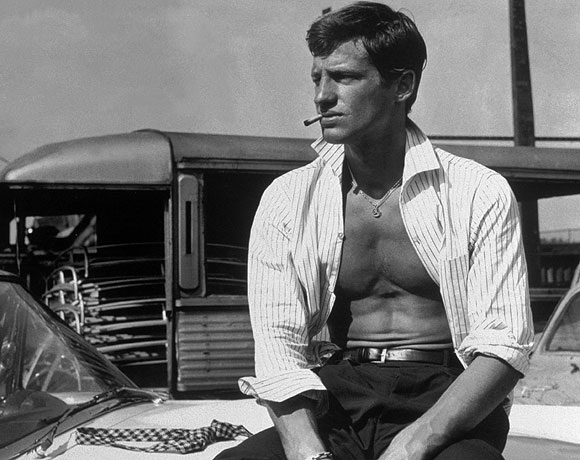
One of the things I love about Melville's work is that his criminals are always career-criminals.
 People who have been in prison before, men who have been fencing stolen jewels for forty years, women who are never surprised when their boyfriends show up with a gunshot wound and don't bat an eye when they are asked to case a house. These people are often attractive, likable, even sexy, but they are also always exhausted. The years of working as hard as they have to stay ahead of the law and away from the assassin's bullet have always taken their toll on their bodies and you can see the weariness in their eyes. These are films about latter-day Hamlets, men and women who have seen too much of life and who are no longer delighted by its charms, who have come instead to see the whole thing as kind of pointless and absurd. In this way, the movies remain, for me, powerful and deeply moving. They're gangster films, sure, but they are also fundamentally about life in the 1950s and 1960s, and if they are formally very different from the films of Godard or Resnais or Truffaut, their content seems, to me, very similar, and just as profound.
29 December 2007
Another December Day in Los Angeles; Another Great Movie
Today I saw There Will Be Blood, the new Paul Thomas Anderson film. PTA is the director of four very good films to date (Hard Eight, Boogie Nights, Magnolia and Punch-drunk Love), but There Will Be Blood is a huge departure for Anderson, who has used most of the same actors and musicians in the last four films. Blood is a Western, and a strange, intense, fucked-up Western at that.
Daniel Day-Lewis is a fiercely competitive oil magnate, who is also almost psychotically misanthropic. The role fits Day-Lewis to a tee, but its Anderson's style (in both writing and directing) that really make There Will Be Blood the bizarre masterpiece that it is. I actually don't want to say too much about the film. It's an intensely weird experience, and it may not be everyone's cup of tea. It certainly isn't as irreverent or sad as Anderson's other movies, and it doesn't hook you emotionally in his usual ways. Instead, Blood is creepy, suspenseful, chilling.
It reminded me, more than anything else, of Jean-Pierre Melville. If the opening ten minutes of There Will Be Blood is like the opening ten minutes of any other film I would say it is like Melville's Le Samouraï, and it isn't just because it lacks dialogue for so long. Blood begins with a bizarre, confusing sound, which I can only imagine is intended to jar its audience, much like the out-of-focus opening of Le Samouraï.
I don't want to say anything more about There Will Be Blood. I need to see it again. And probably a third time.
Daniel Day-Lewis is a fiercely competitive oil magnate, who is also almost psychotically misanthropic. The role fits Day-Lewis to a tee, but its Anderson's style (in both writing and directing) that really make There Will Be Blood the bizarre masterpiece that it is. I actually don't want to say too much about the film. It's an intensely weird experience, and it may not be everyone's cup of tea. It certainly isn't as irreverent or sad as Anderson's other movies, and it doesn't hook you emotionally in his usual ways. Instead, Blood is creepy, suspenseful, chilling.
It reminded me, more than anything else, of Jean-Pierre Melville. If the opening ten minutes of There Will Be Blood is like the opening ten minutes of any other film I would say it is like Melville's Le Samouraï, and it isn't just because it lacks dialogue for so long. Blood begins with a bizarre, confusing sound, which I can only imagine is intended to jar its audience, much like the out-of-focus opening of Le Samouraï.
I don't want to say anything more about There Will Be Blood. I need to see it again. And probably a third time.
18 August 2007
Fists in the Pocket
I know that I frequently complain on this blog about movies about disaffected young people who don't have any direction and mope about their houses. I recently complained about Jean-Pierre Melville's Les Enfants Terribles for doing this, and my distaste for Bernardo Bertolucci's The Dreamers is well documented.
But recently I saw Lindsay Anderson's If...., a very cool story about kids who are unhappy with their status quo and rebel, and today I watched a film by Marco Bellocchio called Fists in the Pocket from 1965. It's about a young man who lives in a villa in the mountains with his younger sister, blind mother, and retarded younger brother. He is sick of this family life and so he rebels against it in an intriguing, vaguely horrifying way: by pushing his mother off a cliff. The boy is such an interesting character, too. I mean, he's obviously pathologically disturbed and all of that, but he's quiet and sad and Bellocchio pays very close attention. We watch his every move and never have a clear idea of what he's going to do. He could really kill anyone at any given moment in the film. It's a very interesting character study.
The extras on the DVD include some cool interviews with the cast and director, and a tribute to the film by Bernardo Bertolucci, which is a fascinating watch.
But recently I saw Lindsay Anderson's If...., a very cool story about kids who are unhappy with their status quo and rebel, and today I watched a film by Marco Bellocchio called Fists in the Pocket from 1965. It's about a young man who lives in a villa in the mountains with his younger sister, blind mother, and retarded younger brother. He is sick of this family life and so he rebels against it in an intriguing, vaguely horrifying way: by pushing his mother off a cliff. The boy is such an interesting character, too. I mean, he's obviously pathologically disturbed and all of that, but he's quiet and sad and Bellocchio pays very close attention. We watch his every move and never have a clear idea of what he's going to do. He could really kill anyone at any given moment in the film. It's a very interesting character study.
The extras on the DVD include some cool interviews with the cast and director, and a tribute to the film by Bernardo Bertolucci, which is a fascinating watch.
01 August 2007
Les Enfants Terribles
Jean-Pierre Melville's 1950 film Les Enfants Terribles was finally released on DVD last week. It is based on a Jean Cocteau novel (subject matter that differs considerably from Melville's usual output.) Following the format of our discussion of Susanne Bier's After the Wedding, I discuss the film with my friend Karen. (She liked it a lot and I rather disliked it.) The following doesn't contain anything major in the way of spoilers.
(As a side note:, I think we should have one of these discussions on Harry Potter and the Order of the Phoenix. Email me and we can set it up!)
***************
I think the main thing is those annoying kids. You remember my reaction to Bertolucci's The Dreamers? I very quickly get irritated with disaffected, bored children with nothing interesting to say. Their relationship was interesting and weird, but the manifestations of that relationship mostly grated on my nerves.
I was expecting something very different from Melville with this film—the Cocteau subject matter is obviously so very different from the other stuff of his we've seen—but I guess I was expecting something a little more, well, mysterious. Any more thoughts?
Melville is obviously a master (that room! the snowball fight!), but Les Enfants Terribles is uneven. I'm thinking of Michael's pop song at the piano: what a strange moment! And the theft of the watering can; to what end? These things made me impatient with Melville's work this time around, and longing for the cool detachment of Le Samouraï, where I have to work a little harder to make meaning of the film.
(As a side note:
Karen: I watched Les Enfants Terribles today. A bizarre movie, even by my standards. I was surprised at how different it is from the other Melville movies – the Cocteau influence. I definitely liked it. All those creepy incestuous undertones, the dead mother, the messy, messy room, the strange mansion, the car wreck, the dream sequence, the Vivaldi. It sure wasn’t Bob le Flambeur though. Did the voiceover bug you? To me it just added to the bizarreness of the film. It was Cocteau’s voice.Me: I didn't like it. Yes, the voiceover bugged me. It always bugs me in films. I don't understand why a filmmaker can't show me the things that the voiceover has to say. I know it solves certain storytelling problems, but it has the effect of flattening everything out.
I think the main thing is those annoying kids. You remember my reaction to Bertolucci's The Dreamers? I very quickly get irritated with disaffected, bored children with nothing interesting to say. Their relationship was interesting and weird, but the manifestations of that relationship mostly grated on my nerves.
I was expecting something very different from Melville with this film—the Cocteau subject matter is obviously so very different from the other stuff of his we've seen—but I guess I was expecting something a little more, well, mysterious. Any more thoughts?
Karen: Annoying kids – you didn’t see that coming from the title? I wonder why annoying children bug you so much. You seem to do ok with annoying adults. Is it because their boredom leads so easily into mindless cruelty?Me: Yeah. I am going to have to put Les Enfants Terribles in a sort-of different category of Melville film in my head. "Early Melville" sounds like a good enough title. There really is no comparison for the kind of gothic brooding, histrionics and head games in this film with his colder, more detached character studies of adults in Bob le Flambeur and even Le Cercle Rouge, which, though not my favorite Melville, is infinitely more absorbing and tension-filled than the Cocteau adaptation.
I think the voiceover is intended to flatten things out in this film and separate the brother and sister further from normalcy and reality. I think that’s why it was all spoken in a monotone. I certainly didn’t care very much about them, and I had a very hard time understanding why Gérard and Agathe were attracted to them. The sister was scary and the brother was completely self-absorbed. Well, she was self-absorbed too. I was fascinated by the strange way she dressed – high heels and a bathrobe, for starters. But she sure didn’t dress like a 16 or 17 year old girl, ever. That’s maybe what interested me about the film – I was fascinated and a little repulsed by their bizarreness. It wasn’t eccentricity, it was psychopathological. I do remember wondering where the film was going with all this, and thinking that it could only end in tragedy.
I like Melville’s storytelling much better. I wonder what his other early movie, Silence de la Mer, is like. It also is based on someone else’s story. My love for Melville remains with his gangster movies and Army of Shadows.
Melville is obviously a master (that room! the snowball fight!), but Les Enfants Terribles is uneven. I'm thinking of Michael's pop song at the piano: what a strange moment! And the theft of the watering can; to what end? These things made me impatient with Melville's work this time around, and longing for the cool detachment of Le Samouraï, where I have to work a little harder to make meaning of the film.
Karen: Oh that song violently clashed with the entire rest of the movie. I forgot about that. There was a lot of controversy about how much it was Cocteau’s film and how much Melville’s – in the interviews on the disk and stuff I’ve read about it. But it’s clear to me that Cocteau was really driving this story because it is so different from the later Melville. Make it Cocteau-Melville for your separate category. There were some wonderful scenes in the film (that I attribute entirely to Melville). Also the ending was Melville’s. Cocteau wanted some dumb thing where they were laying on the bed together in each other's arms or something. Melville had the whole screen-falls-down thing. Not that hard to figure out the symbolism there. The stealing was part of their game. The watering can part was weird because it really should have been an initiation for Gérard, but it didn’t seem to function that way. Well maybe –didn’t he start sleeping on their floor after that?Me: No, that's the thing. It's just that Dreamers is about disaffected young people whining about stupid shit. My sympathies run very thin with those kinds of movies. Give me a hard-boiled criminal any day over a miserable teenager.
I can definitely see how this movie disappointed you if you were expecting it to be like his other stuff. That has happened to me more times than I can say. I realized immediately that this was going to be a totally different kind of movie – partially because the voiceover starts explaining everything right off the bat – and somehow was able to switch gears. But I’m sticking with my “like” vote. Not love, but not dislike. But you’ve actually had a while to think about it so you’re probably not going to feel that much different about it. And you’re right about it being uneven.
There are movies that stick with me for days and others that fade almost immediately. The other Melville films were stickers. This one begins to fade already.
I only vaguely remember you talking about The Dreamers. Is it as different from Bertolucci’s other work as Les Enfants Terribles is from the rest of Melville’s?
04 June 2007
L.A. Update #2
I've been keeping busier. Last night I went to see Luisa Fernanda at Los Angeles Opera. It was delightful. I hated the set, but I had never seen a zarzuela before, and this was a really cool experience particularly because I got to hear Plácido Domingo sing the lead male role. Boy does that man have a voice!
Being downtown made my heart ache to live in Los Angeles again. There's Southern California and there's Southern California. I realized today that I like living in Tallahassee a lot better than I like living in La Verne (where my folks live). Everyone is so white out here and it all feels so... I don't know how else to describe it except by using the word fake. Everything is a chain store: chain coffee and chain restaurants and chain clothing stores and more chain restaurants. Chain hardware stores and chain movie rental stores. Chain jewelry stores, chain bagel shops and chain auto mechanics. It's a town without a bookstore. At least Tallahassee feels lived in. It's an eerie feeling: like living in a big Hollywood movie where everything is predictable.
But downtown doesn't feel like that at all. It feels different and new and messy and unpredictable. I went to the opera with Derek. We didn't even dress up: jeans and dress shirts. And we had a great time. It's just so nice down there. And the weather! I love Los Angeles.
I finished Eve Kosofsky Sedgwick's book Epistemology of the Closet which is really brilliant. And I started Foucault's The History of Sexuality Part II: The Use of Pleasure, but I am getting a little bored. I need some fiction in my life, I think. Maybe I will pick up some Noël Coward for a lark.
I've been watching movies too. Melville's Bob le Flambeur (1956) is easily as good as his later masterpieces Le Samouraï and Le Cercle Rouge. I am in LOVE with Jean-Pierre Melville. This man makes some brilliant fucking movies. Bob is an über-cool heist film without a heist. And it's an obvious predecessor to what would be called the French New Wave. The French New Wave would have been unthinkable without Bob le Flambeur (or, I think, Louis Malle's Elevator to the Gallows, another must-see from the 1950s.) It's a mid-1950s noir, betraying Melville's fascination with all things Yankee, but it's attitudes and self-satisfaction are unmistakeably French. Add this one to your Netflix queue.
Captain Blood is your standard Errol Flynn swashbuckler. The first one, I think. I'd never seen it, and I liked it a lot. There isn't quite enough swordfighting for my taste, but it's totally fun nonetheless and the cinematography is amazing. It also stars Olivia de Havilland, who was in all of those 1930s Errol Flynn pictures with him—before she finally escaped with Gone with the Wind and started racking up Oscars for her shelves.
Everyone's been hailing Once as a new kind of movie musical. It's a really good film, but it isn't really a watershed event in movie musical history or anything like that. Actually, it's not even really a musical so much as it is a movie with a lot of music in it. The movie follows an aspiring musician in Ireland as he records his first album and falls in love. It's filled with songs that he strums out on a guitar. I really liked it, and it has a near-perfect ending, but don't go in expecting it to change your life. It's just a really cool indie.
And Sympathy for Lady Vengeance is no Oldboy. That's all I'm saying.
Being downtown made my heart ache to live in Los Angeles again. There's Southern California and there's Southern California. I realized today that I like living in Tallahassee a lot better than I like living in La Verne (where my folks live). Everyone is so white out here and it all feels so... I don't know how else to describe it except by using the word fake. Everything is a chain store: chain coffee and chain restaurants and chain clothing stores and more chain restaurants. Chain hardware stores and chain movie rental stores. Chain jewelry stores, chain bagel shops and chain auto mechanics. It's a town without a bookstore. At least Tallahassee feels lived in. It's an eerie feeling: like living in a big Hollywood movie where everything is predictable.
But downtown doesn't feel like that at all. It feels different and new and messy and unpredictable. I went to the opera with Derek. We didn't even dress up: jeans and dress shirts. And we had a great time. It's just so nice down there. And the weather! I love Los Angeles.
I finished Eve Kosofsky Sedgwick's book Epistemology of the Closet which is really brilliant. And I started Foucault's The History of Sexuality Part II: The Use of Pleasure, but I am getting a little bored. I need some fiction in my life, I think. Maybe I will pick up some Noël Coward for a lark.
I've been watching movies too. Melville's Bob le Flambeur (1956) is easily as good as his later masterpieces Le Samouraï and Le Cercle Rouge. I am in LOVE with Jean-Pierre Melville. This man makes some brilliant fucking movies. Bob is an über-cool heist film without a heist. And it's an obvious predecessor to what would be called the French New Wave. The French New Wave would have been unthinkable without Bob le Flambeur (or, I think, Louis Malle's Elevator to the Gallows, another must-see from the 1950s.) It's a mid-1950s noir, betraying Melville's fascination with all things Yankee, but it's attitudes and self-satisfaction are unmistakeably French. Add this one to your Netflix queue.
Captain Blood is your standard Errol Flynn swashbuckler. The first one, I think. I'd never seen it, and I liked it a lot. There isn't quite enough swordfighting for my taste, but it's totally fun nonetheless and the cinematography is amazing. It also stars Olivia de Havilland, who was in all of those 1930s Errol Flynn pictures with him—before she finally escaped with Gone with the Wind and started racking up Oscars for her shelves.
Everyone's been hailing Once as a new kind of movie musical. It's a really good film, but it isn't really a watershed event in movie musical history or anything like that. Actually, it's not even really a musical so much as it is a movie with a lot of music in it. The movie follows an aspiring musician in Ireland as he records his first album and falls in love. It's filled with songs that he strums out on a guitar. I really liked it, and it has a near-perfect ending, but don't go in expecting it to change your life. It's just a really cool indie.
And Sympathy for Lady Vengeance is no Oldboy. That's all I'm saying.
25 June 2006
Movie Sum-up Post
I have seen about ten movies since I last wrote about one in this space. This sucks as a movie blog. I hope no one's here for that because I'm not very good at movie-blogging as it turns out. Nevertheless, I bring you reviews (albeit, short) of the ten films I've seen this year that I haven't written about.
This afternoon: Robert Altman's very musical extravaganza A Prairie Home Companion, which is full of lovely jokes, down-home humor and the brilliant non-sequitor-filled silliness of both Altman films and Garrison Keillor's weekly radio program. There are some really fun segments of the show absent from the film, but one cannot have everything and the movie is a delight from start to finish, featuring really wonderful performances from a whole cast of greats, but especially Meryl Streep & Lily Tomlin and Woody Harrelson & John C. Reilly as two singing duos. My favorite performance in the film is from Marylouise Burke, who plays the lunch lady.
Josef von Sternberg's Morocco starring the totally fabulous Marlene Dietrich in her only Oscar-nominated performance is fairly standard fare as films go... or so I thought for the first half hour or so. The film's plot is standard, but Dietrich herself is a force with which to be reckoned. The much-talked about scene with her performing a cabaret act in a tuxedo and kissing a woman full on the lips is in Morocco and I must confess that it took me completely by surprise and I was instantly in love. The movie is only okay, but Dietrich is incredible. I'm hooked.
Sudden Fear is a later Joan Crawford vehicle starring a past-her-prime Crawford and a supposedly charismatic and charming Jack Palance (!). For me the film failed on all counts, except that it features the compelling-yet-irritating Gloria Grahame (who I grudgingly love). I don't like Joan Crawford; I've decided. I know it's, like, sacrilege, or something. ...And here's the thing: I don't think it's a rational dislike of Crawford. I think I dislike her because Bette Davis so disliked her. As one of my co-workers said, I should start to hate half of old-Hollywood if my loyalty runs so deep: Ms. Davis could've paved a street with the names of people she despised, but I really think that's it. Still it isn't rational. I love Celeste Holm and Ms. Davis loathed her, so... I have no explanation other than I think Ms. Crawford can't act for shit, doesn't particularly have nice legs (a feature with which Sudden Fear seemed obsessed) and isn't particularly pretty--by any yardstick. Sue me in gay court later.
I really liked Jason Reitman's Thank You for Smoking. I thought it was very, very funny in an offbeat, irreverent, punishing sort of way and the script is really clever. The acting is good, for the most part, with some excellent performances from Robert Duvall and Maria Bello, especially. I loved the kid, too: Cameron Bright (from the lackluster Birth). Mostly this is just a funny, funny movie. Three things, though: 1) Katie Holmes looks like a little kid. I cannot believe her in any role. I couldn't believe her as a lawyer in Batman Begins, and I didn't buy her for a second as a reporter in Thank You for Smoking. She looks like she couldn't even buy a pack of smokes if she wanted to. 2) My boy Aaron Eckhart's hair. Couldn't they have hired someone to fix it. It looked awful throughout and he tried, like, three different styles. The last thing 3) is my favorite performance in the film: Adam Brody as Rob Lowe's assistant. He plays the role perfectly, with excellent timing and an excitement I am unused to seeing.
George Cukor's Born Yesterday features the performance that beat both Bette Davis's All About Eve turn as Margo Channing and Gloria Swanson's genius turn as Norma Desmond in Sunset Boulevard. I have generally avoided Born Yesterday for this reason (more solidarity with Ms. Davis: see above). But I was mistaken. This one's a crowd pleaser. The script is wonderful and Judy Holliday is absolutely wonderful. I adored her character and fell in love with her. It's a great star turn and worthy of all its accolades.
Jean-Pierre Melville's Le Cercle Rouge is the epitome of cool. I liked it even better than Le Samouraï. It's not quite as good as Army of Shadows, but, then, few films are. I find Melville's ideas about the prices men have to pay for the things they do slightly objectionable. I prefer Woody Allen's ideas about men (i.e. I like them to get away with things.) The films are so cool, though, that Melville has to be forgiven. Watch Le Cercle Rouge and your teeth will hurt the movie is so fucking cool. I swear to god.
Rainer Werner Fassbinder's Ali: Fear Eats the Soul is a sort-of remake of Douglas Sirk's All That Heaven Allows, the film on which Todd Haynes based his gorgeous Far from Heaven. Fassbinder's film is beautiful and ugly, harsh, soft, shocking, horrifying, sad and dificult all at the same time. I became connected to the characters instantly and the emotional work that Fassbinder is doing is undeniable, but his filmmaking skill is so pronounced, his language so stark and stunning and his references to Sirk so clear, that it's hard not to pay attention to the look of the film and let go of the matter of the film. To do so would be to miss so much, though. Ali is a fascinating, subtle tale with much to say about German xenophobia and fear of "the other" in general.
I'm not sure why everyone is so apeshit about Jean-Luc Godard's À Bout de Souffle (Breathless). It's good, sure, and it's cool. Maybe I'm too old. The only thing I really loved about it was the ending, which is really quiet and subtle... I think that's what I don't love about the film: I feel like it isn't doing anything very subtle, or perhaps the legacy it has left has so overwhelmed the context of the film that I can't see the forest for the trees. Maybe it's been copied so frequently and so poorly that even the original lacks luster for me.
Okay... last one:
Terry Zwigoff's Art School Confidential is stupid. I may have laughed a couple of times. When it is exploring the nature of art and asking us what is good and what isn't, I found the film really interesting, but all of the silliness and its ludicrous cast of characters (every single stereotype imaginable) had no charm for me. I have a lot of bad things to say about this movie: almost nothing good in fact, so I'll shut up now. Suffice to say that I didn't like the film at all. Max Minghella is a cutie, but I hope he sticks to better stuff than this in future. And I so liked Ghost World...
This afternoon: Robert Altman's very musical extravaganza A Prairie Home Companion, which is full of lovely jokes, down-home humor and the brilliant non-sequitor-filled silliness of both Altman films and Garrison Keillor's weekly radio program. There are some really fun segments of the show absent from the film, but one cannot have everything and the movie is a delight from start to finish, featuring really wonderful performances from a whole cast of greats, but especially Meryl Streep & Lily Tomlin and Woody Harrelson & John C. Reilly as two singing duos. My favorite performance in the film is from Marylouise Burke, who plays the lunch lady.
Josef von Sternberg's Morocco starring the totally fabulous Marlene Dietrich in her only Oscar-nominated performance is fairly standard fare as films go... or so I thought for the first half hour or so. The film's plot is standard, but Dietrich herself is a force with which to be reckoned. The much-talked about scene with her performing a cabaret act in a tuxedo and kissing a woman full on the lips is in Morocco and I must confess that it took me completely by surprise and I was instantly in love. The movie is only okay, but Dietrich is incredible. I'm hooked.
Sudden Fear is a later Joan Crawford vehicle starring a past-her-prime Crawford and a supposedly charismatic and charming Jack Palance (!). For me the film failed on all counts, except that it features the compelling-yet-irritating Gloria Grahame (who I grudgingly love). I don't like Joan Crawford; I've decided. I know it's, like, sacrilege, or something. ...And here's the thing: I don't think it's a rational dislike of Crawford. I think I dislike her because Bette Davis so disliked her. As one of my co-workers said, I should start to hate half of old-Hollywood if my loyalty runs so deep: Ms. Davis could've paved a street with the names of people she despised, but I really think that's it. Still it isn't rational. I love Celeste Holm and Ms. Davis loathed her, so... I have no explanation other than I think Ms. Crawford can't act for shit, doesn't particularly have nice legs (a feature with which Sudden Fear seemed obsessed) and isn't particularly pretty--by any yardstick. Sue me in gay court later.
I really liked Jason Reitman's Thank You for Smoking. I thought it was very, very funny in an offbeat, irreverent, punishing sort of way and the script is really clever. The acting is good, for the most part, with some excellent performances from Robert Duvall and Maria Bello, especially. I loved the kid, too: Cameron Bright (from the lackluster Birth). Mostly this is just a funny, funny movie. Three things, though: 1) Katie Holmes looks like a little kid. I cannot believe her in any role. I couldn't believe her as a lawyer in Batman Begins, and I didn't buy her for a second as a reporter in Thank You for Smoking. She looks like she couldn't even buy a pack of smokes if she wanted to. 2) My boy Aaron Eckhart's hair. Couldn't they have hired someone to fix it. It looked awful throughout and he tried, like, three different styles. The last thing 3) is my favorite performance in the film: Adam Brody as Rob Lowe's assistant. He plays the role perfectly, with excellent timing and an excitement I am unused to seeing.
George Cukor's Born Yesterday features the performance that beat both Bette Davis's All About Eve turn as Margo Channing and Gloria Swanson's genius turn as Norma Desmond in Sunset Boulevard. I have generally avoided Born Yesterday for this reason (more solidarity with Ms. Davis: see above). But I was mistaken. This one's a crowd pleaser. The script is wonderful and Judy Holliday is absolutely wonderful. I adored her character and fell in love with her. It's a great star turn and worthy of all its accolades.
Jean-Pierre Melville's Le Cercle Rouge is the epitome of cool. I liked it even better than Le Samouraï. It's not quite as good as Army of Shadows, but, then, few films are. I find Melville's ideas about the prices men have to pay for the things they do slightly objectionable. I prefer Woody Allen's ideas about men (i.e. I like them to get away with things.) The films are so cool, though, that Melville has to be forgiven. Watch Le Cercle Rouge and your teeth will hurt the movie is so fucking cool. I swear to god.
Rainer Werner Fassbinder's Ali: Fear Eats the Soul is a sort-of remake of Douglas Sirk's All That Heaven Allows, the film on which Todd Haynes based his gorgeous Far from Heaven. Fassbinder's film is beautiful and ugly, harsh, soft, shocking, horrifying, sad and dificult all at the same time. I became connected to the characters instantly and the emotional work that Fassbinder is doing is undeniable, but his filmmaking skill is so pronounced, his language so stark and stunning and his references to Sirk so clear, that it's hard not to pay attention to the look of the film and let go of the matter of the film. To do so would be to miss so much, though. Ali is a fascinating, subtle tale with much to say about German xenophobia and fear of "the other" in general.
I'm not sure why everyone is so apeshit about Jean-Luc Godard's À Bout de Souffle (Breathless). It's good, sure, and it's cool. Maybe I'm too old. The only thing I really loved about it was the ending, which is really quiet and subtle... I think that's what I don't love about the film: I feel like it isn't doing anything very subtle, or perhaps the legacy it has left has so overwhelmed the context of the film that I can't see the forest for the trees. Maybe it's been copied so frequently and so poorly that even the original lacks luster for me.
Okay... last one:
Terry Zwigoff's Art School Confidential is stupid. I may have laughed a couple of times. When it is exploring the nature of art and asking us what is good and what isn't, I found the film really interesting, but all of the silliness and its ludicrous cast of characters (every single stereotype imaginable) had no charm for me. I have a lot of bad things to say about this movie: almost nothing good in fact, so I'll shut up now. Suffice to say that I didn't like the film at all. Max Minghella is a cutie, but I hope he sticks to better stuff than this in future. And I so liked Ghost World...
12 May 2006
This Weekend
I won't get to see that many movies, so you should go for me and post comments telling me how they all are...
Out this week: Army of Shadows, by Jean-Pierre Melville. It's the first time it has been released in this country and I'm so excited!
Also out this week: nothing else I'm interested in.
There is still a lot of stuff currently in theatres that I haven't seen (Thank You for Smoking, Water, Art School Confidential, Friends with Money, Hard Candy.) Hopefully I will get to go to the cinema soon.
Out this week: Army of Shadows, by Jean-Pierre Melville. It's the first time it has been released in this country and I'm so excited!
Also out this week: nothing else I'm interested in.
There is still a lot of stuff currently in theatres that I haven't seen (Thank You for Smoking, Water, Art School Confidential, Friends with Money, Hard Candy.) Hopefully I will get to go to the cinema soon.
31 January 2006
Le Samouraï
You've probably never seen Jean-Pierre Melville's 1967 film Le Samouraï. I'll wager you've probvably never even heard of it. I barely heard of it a month or two ago when The Criterion Collection released a DVD of the film. After reading a brief synopsis, I immediately put in my Netflix queue. I was beat to the punch, though, when my boss came back from lunch one day in December with the DVD in her possession.
Anyway, I saw it tonight. And if you've never heard of it, seen it, whatever, you need to. Rent it or put it in your Netflix queue or do whatever it is you do to see films, but go see this one.
It's about a lone wolf assassin named Jef Costello (Alain Delon) with all the right moves and an air of silence that makes you want to scream or die or I don't know what. He's so cool I could barely contain myself and the movie is a taut, achingly intelligent thriller. Awesome. See it now.
More complete thoughts on the Academy Award nominations tomorrow. Sorry, but I was up early to see them and I've been processing them all day. I could have blogged earlier, but my student showed and we did about two hours of work and then Le Samouraï beckoned.
Briefly, though: Amy Adams!!!! and William Hurt!!! Both of those nominations delighted me. The New World picked up one nomination, which is one more than I expected, frankly, though it is my favorite film of the year. Other exciting things: Terrence Howard for Hustle & Flow and "It's Hard out Here for a Pimp" (who thought that would be nominated?) Congrats also to my second favorite film of the year, Brokeback Mountain, which leads with eight nominations and will handily pick up the big trophy on March the fifth.
More tomorrow...
Anyway, I saw it tonight. And if you've never heard of it, seen it, whatever, you need to. Rent it or put it in your Netflix queue or do whatever it is you do to see films, but go see this one.
It's about a lone wolf assassin named Jef Costello (Alain Delon) with all the right moves and an air of silence that makes you want to scream or die or I don't know what. He's so cool I could barely contain myself and the movie is a taut, achingly intelligent thriller. Awesome. See it now.
More complete thoughts on the Academy Award nominations tomorrow. Sorry, but I was up early to see them and I've been processing them all day. I could have blogged earlier, but my student showed and we did about two hours of work and then Le Samouraï beckoned.
Briefly, though: Amy Adams!!!! and William Hurt!!! Both of those nominations delighted me. The New World picked up one nomination, which is one more than I expected, frankly, though it is my favorite film of the year. Other exciting things: Terrence Howard for Hustle & Flow and "It's Hard out Here for a Pimp" (who thought that would be nominated?) Congrats also to my second favorite film of the year, Brokeback Mountain, which leads with eight nominations and will handily pick up the big trophy on March the fifth.
More tomorrow...
Subscribe to:
Posts (Atom)