Love and scandal are the best sweeteners of tea. —Henry Fielding
Showing posts with label violence. Show all posts

11 August 2023

Mission: Impossible – Dead Reckoning Part One


Did a bot write this? Honestly I wouldn’t be surprised. This was very very silly but not without its charms. I do wish I had seen this on an IMAX screen. It's so dumb that it's main pleasures are watching Tom Cruise run (I'm being completely serious) and the big action setpieces with which the film is littered. This stuff really is good fun, and so one might as well lean into that by seeing this thing on the biggest screen possible. 

There is, however, a paradox in PG-13 films like M:IDR1. They purportedly shield young people (under 13) from seeing too much violence. At the same time, their plots are about saving the entire world from succumbing to violent destruction. And yet they irresponsibly show the most brutal, horrible physical violence as if it has no consequences at all. You can get your face slammed into a stone wall and come right back to fight some more, and you can get your hand stabbed into a table and not bleed a drop. So while PG-13 films such as this (and the ones cranked out by Marvel Studios) purport to be opposed to violence, they make the world more and more violent by pretending that terrible violence does no harm. 

15 December 2019

Spetters (1980)

Well Spetters is a stunning early Paul Verhoeven film from 1980. There is a lot to say about it, but it is especially notable for a storyline in which a young man is beating up gay hustlers and stealing their money in order to appeal to a young woman who only likes guys with money. But then a gang of four men, led by the woman's brother, rapes this young guy, who, as it turns out, was behaving in this homophobic way because he is actually queer. This entire storyline is fascinating, and I expect I'll probably need to watch this film a couple more times.

22 September 2016

American Fascism and the Mid-1930s

So I watched this Howard Hawks movie called Barbary Coast this morning. It is from 1935 and starred the great Miriam Hopkins. Hopkins was a big star by 1935 and was nominated as Best Actress in that year for a different film, an adaptation of Thackeray's Vanity Fair called Becky Sharp.

In any case, Barbary Coast is about a young woman who comes to San Francisco during the gold rush and finds her fiancé murdered when she gets off of the boat. But because the only reason she's come to California is for gold, she very quickly hooks herself up with her fiancé's murderer, the man who stole her man's gold in the first place. This evil gangster is Edward G. Robinson, of course, and he swaggers around town taking lives and insulting women and doing his best to make everyone simultaneously uncomfortable and obedient. (He is also earringed, pomaded, and given an Italian surname so that we clearly read him as a foreigner.)

Miriam Hopkins accidentally falls in love with a naive forty-niner played by Joel McCrea who quotes Shelley to her and talks about riding ponies in Grammercy Park.

Robinson is angry, of course, and tries to have him killed, but by this time the town has rebelled. Furious with the giant thumb under which the townsfolk have been living, they lynch one of Robinson's henchmen (Brian Donlevy) and then come after Robinson himself, rifles cocked at the ready. I am sure you can guess who wins out in the end. This is old-school melodrama, and everything works out as you'd expect.

This being Howard Hawks, this is very well made old-school melodrama, and the photography in particular is gorgeous. But what has sort of stuck in craw after having seen Barbary Coast is this group of townsfolk who wind up killing Donlevy (who is, after all, a murderer). They call themselves vigilantes, and a little note on this word will, perhaps, make sense of my discomfort. Vigilante comes from the Spanish, which makes perfect sense for a movie set in the 1840s in California, but the real rise in the use of this word in Anglophone literature happens at precisely the time when Barbary Coast is released – in 1935. Run your cursor over the graph below and you'll see what I mean.


It was the lawlessness with which law and order was restored to San Francisco in the film that bothered me so much. The men with the rifles were doing the right thing, of course. They were getting revenge for their murdered friends, and they were punishing a man who was hubristically killing anyone he pleased, and they were putting power back in the hands of the people, wresting it from a lawless, greedy gangster who had only his own interests at heart. But... if the film's title is supposed to be a reference to lawless barbarianism and the rule of the gun, I don't think this group of vigilantes restores law and order in any appreciable way. Rather, they simply underline the rule of the gun and maintain the lawlessness of the land, merely transferring the power of the gun to the "good guys" and wresting that power from the "gangster".

Ms. Hopkins Making the Most of It
What troubled me was that Barbary Coast seemed designed to incite this kind of violence, to ask USAmericans to take justice into their own hands. After all, if the law won't do it, who will? Why, we vigilantes, that's who! This wouldn't be so scary if this weren't 1935, a year not so far removed from the 1931-1932 trials of the Scottsboro defendants. 1935 – a year in which 2 white men and 18 black men were lynched (the last double-digit year for lynchings in the U.S.) and a year in which anticommunism had become rampant, as the the Special Committee on Un-American Activities Authorized to Investigate Nazi Propaganda and Certain Other Propaganda Activities met in the House of Representatives under the leadership of John William McCormack and Samuel Dickstein. This decade would see a few men in the U.S. government all but completely shut down the progressive movement that comprised the Old Left.

Robinson Looks Up at the Lynched Donlevy
These vigilantes aren't a lynch-mob; far from it. They're a group of men who have a legitimate grievance, who feel slighted by the men in charge, who feel marginalized by a ruling class who are telling them what to do and stealing their money. And so they get a bunch of guns and they go kill a man. They do this dispassionately and deliberately, and they do it without any ethical quandary. Barbary Coast, too, attaches no ethical dilemma to the lynching of Donlevy. It is simply justice.

I would like to return briefly to the title. Barbary Coast is not a phrase historically used to describe California or San Francisco. The phrase was generally used in reference to the Amazighen or Berber people from the north coast of Africa – modern Algeria, Tunisia, and Morocco. (The Romans used the term barbar to describe foreigners, whose language all sounded like "bar-bar" to them.) And if Barbary Coast's lynching on the west coast of North America in the 1840s seems far removed from ancient North Africa, perhaps the unmentioned but – it seems to me – clearly disavowed possibility of lynching in the African Diaspora of the American South in the 1930s allows for the title's evocation of Africa to make a bit more sense. In a land of barbarians (Barbary was best known for its pirates and its slave-traders), in a land where the government cannot be counted on to mete out justice, red-blooded Americans (Barbary Coast seemed to me to say) need to take the law into their own hands: the precise opposite, in other words, of law and order.

12 February 2016

Grey Areas

Fifty Shades of Grey is laughable for many, many reasons, and I spent much of the film riotously cackling at its nonsense, but I was, I must admit, left with a few questions after the final elevator doors closed and (spoiler alert) Christian Grey and Anastasia Steele said goodbye-for-now.

What a caretaker!
Leading the list of my questions is the very plot of this film, which, in effect, concerns a single question: Will Anastasia sign a very long contract that gives Christian legal immunity so that when he hurts her during sex she won't sue him? Will she sign this document or won't she? When Anastasia asks Christian what it is that she gets for signing this document, Christian's response is "me". I found this surprising mostly because the response wasn't related to Anastasia's own pleasure: Anastasia is not supposed to get pleasure out of these sexual encounters but instead understands these sexual encounters as a kind of currency that she uses in exchange for Christian "himself", a self we come to find out does not refer to his body (Anastasia is not allowed to touch him, according to the contract) but his wealth and his family connections. Anastasia is supposed to sign a contract that exchanges her submissiveness in sadomasochistic sexual situations not for the pleasure of those situations but for (what amounts to) a series of expensive gifts.

He plays the piano.
This is the film's plotline. Christian tries to convince Anastasia to sign this contract; she resists signing it.

Anastasia doesn't understand why she and Christian can't just be boyfriend and girlfriend. Why can't they just hang out and watch Netflix? (I don't do the boyfriend thing, he says sullenly.) Why do they have to have elaborate theatrical sex during which she will feel some amount of pain. She asks him: Why do you want to hurt me? Again the language is oddly fixated on inflicting harm and not on the pleasure that both the dom and the sub take in BDSM sex practices.

If Fifty Shades' plot is one that hinges on the granting or withholding of consent, it is worth noting that Anastasia does not, after all, sign the contract. In other words, officially, Anastasia withholds her consent from these sex practices. The film sets up this additional threshold of consent – she is to sign a contract – and, because it is a document that needs to be signed or not signed, it is always extremely clear that Anastasia does not cross this threshold. Perhaps surprisingly, this withheld consent does not stop her from having (and enjoying) sex with Christian, and it doesn't stop her from willingly yet hesitantly participating in some of the sex practices he has proposed. In other words, Anastasia both withholds her consent and grants it.

Fifty Shades, to be clear, represents a woman who says no, who says no repeatedly, but who actually means yes. She always officially says no, but what she actually wants is for her lover to convince her. At one point she actually texts him "Nice knowing you", but when he shows up with wine and ice (?) and tells her she didn't mean that at all, she completely agrees. No, she didn't mean she was done with him forever. She meant: try a different tactic and then perhaps the answer will be yes.

If there are shades of grey in Fifty Shades, it seems to me that what the film is shady about is the difference between yes and no, the difference between consensual sex and non-consensual sex. Fifty Shades firmly believes that a woman saying no is simply a request for a man to pursue further negotiations. No is a grey area that might mean, probably means, could eventually mean, simply yes.

* * *
And another thing: as much as this film seems fascinated by kink and is willing to use it to titillate its audience, Fifty Shades is also surprisingly normative. I don't make love. I fuck. Hard, Christian tells Anastasia early in the film. But, we will come to find out, he is full of lies. He is happy to make sweet sweet love to the film's protagonist, and even spend the night with her, arms intertwined. He will protest, of course, that he doesn't do such things, he's not the boyfriend type, but, as it turns out, he absolutely does do those things. Mr. Grey spends much of the film holding Anastasia's hand, holding her face in his hands, caressing her lower lip, performing cunnilingus on her, caressing her with the feathers of peacocks, washing her back in a bathtub they share. And that's when he's not playing the piano, lifting her gently and carrying her to bed, dancing with her around his penthouse, posing for pictures with his arm around the small of her back, flying her around in his helicopter, or introducing her to his parents as his girlfriend. What's interesting about this is that Christian is obviously some kind of romantic heteronormative fantasy: he is simultaneously the image of the perfect future-husband who is rich and well dressed and can fly a helicopter and also the bad boy who hides his true feelings and secretly wants to hurt you.

Christian, I feel like there is something between us. Like a windshield.
I resent, of course (and we ought perhaps all to resent) the implication that Christian Grey is interested in his kinks because he is somehow damaged, because he is, as he says in the film's third act, "fifty shades of fucked up". This is absurd and offensive. This is equivalent to saying that his sexual tastes are somehow wrong as opposed to being one instance of the wide (and benign) variety of human sexuality. Grey has developed particular sexual interests and, as far as we were shown in this film, they weren't all that fucked up. What they were were specific. And anyway he is clearly capable of doing all of the things that heternormative vanilla sex deems appropriate (holding hands, cunnilingus, gentle caresses, etc.). If he doesn't want to do those things, that is his business, and if Anastasia doesn't want to have sex with him in the way that he wants to have sex, she is free to reject him and his floggers at any point. Furthermore, the caning sequence that somehow pushes Anastasia over the edge and convinces her (at least for now) that Christian is too far gone to be redeemed, is staged almost explicitly as a non-sexual encounter, in which he is hitting her only to hit her. If this is a kink, where is the eroticism?

(One might also ask why Christian Grey doesn't simply go on the internet and find a woman who is into his tastes from the get-go instead of trying to convince this college girl that she really will like it, no trust me.)

Fasten your seatbelts. It's going to be a bumpy night.
And I guess this is none of my business – Sam Taylor-Johnson can put whatever fantasies she likes on her screen – but might I wonder aloud about how a film like this, directed by a woman and written by a woman, barely manages to pass the Bechdel test? Why doesn't Anastasia talk about this weird relationship she's in with, oh I don't know, her best friend and roommate? Or, perhaps, her mother? Our heroine could've used a little perspective, I feel. But instead she lies to both her roommate and her mother about Mr. Grey. What on earth is the point of having her do this? Why not have a simple conversation with another woman in your life? A bit of female solidarity, and perhaps some good advice, would, I feel, have helped this college senior a great deal.

I had numerous other problems with this movie, of course – mostly because it was a terrible film – but I see no reason to go into them. Fifty Shades, if it is anything, is a purely unrealistic rape-fantasy; the movie is simply a series of fantastic romantic images all of which involve the hope that the man of one's dreams won't take no for an answer. Christian Grey himself is merely the projection of many of those desires. There is much, perhaps, that is intriguing here about the way that Fifty Shades represents the fantasy of the white American (mostly) heterosexual woman in the early 21st century. These fantasies are, I will confess, darker than I had thought. But they strike me as dark not because of their propensity toward kink, but because what is clear in this version of the female fantasy is that the film simply refuses to be clear about what we think we in the 21st century mean by the word rape. The shades of grey upon which this film is predicated are all between the word yes and the word no.

09 November 2015

Beasts of No Nation

Clearly one of the best films of the year so far is Cary Joji Fukunaga's Beasts of No Nation.

It is true that I generally find it difficult to find a lot of words when I am talking about a movie that I simply love without almost any reservation, but I am holed up in the Portland airport waiting for a red-eye back to Central Florida from the ASTR conference, and I am way too tired to read. In other words, forgive me if this post is out of control; know that I have slept very little the last few days and won't get to sleep for another large number of hours.

Beasts of No Nation is a film about child soldiers, better even than 2013's War Witch. This is a film mostly in English and it is upsetting a lot of people because it is being released on Netflix simultaneously with its (Academy-qualifying) theatrical release. Distributors can say whatever they like about this, however. It will not alter the fact that this is a superb film.

If War Witch is Beasts of No Nation's most obvious recent cinematic reference point, if you ask me the film's debts are primarily to the ecologically minded utter genius filmmaker Terrence Malick. Malick's style isn't copied here – that would be profoundly unfair – but many of Fukunaga's questions about the world are the same. Like Malick, Fukunaga is fundamentally interested in the natural world that violence destroys and the ways that adults have powerful effects on children.

I am evoking Malick, too, because Fukunaga uses (but does not overuse, as some of Malick's acolytes do) a voiceover technique, where the film's main character articulates to us the reasons he has made the decisions he's made and the ways he deals with the psychic wounds of having done what he has been forced to do. This allows Fukunaga (who also wrote the screenplay) to describe the wounds experienced by a character while at the same time turning his camera on the jungle or on plant- or animal life.

Both filmmakers also present the violence in their films in fundamentally ethical ways, treating acts of bloodshed with horror and surprising the audience with the viciousness exhibited by their characters. Fukunaga doesn't let us be sentimental about violence without then following sentiment with ruin, with terrifying details that shock us out of our tendency only to mobilize the default emotions of pity or fear. (I guess I shouldn't speak for all of us, but I am convinced that this is how these things work so I'm just going to keep talking.) Sequences of excessive violence treated with a truly horrifying perspective have the power to unsettle us deeply, so that once we move past pity or shallow sentimentality, we can move into an area where we no longer feel like we understand this violence's limits. What I think this refusal to allow us to see violence's limits does is transmit to us a deep feeling that we no longer understand what humans are capable of doing. It becomes clear – we know in our bodies – that there are worse things than the director has allowed us to see. We know we have not understood. Beasts of No Nation does not let us rest in the complacency of believing we "get" it. The limit Fukunaga's film makes clear is not the limit of the violence of child soldiery but the limit of our ability to think it.

It is this kind of superb moviemaking for which Fukunaga has come to be recognized. Think about some of the sequences in True Detective's first season; there were entire sections of that show when my jaw was in a permanently dropped position.

Mr. Attah
It goes without saying that the film's photography is breathtakingly detailed and exquisite. Fukunaga was his own DP, and the film's cinematography is precisely what we have come to expect from his camera: images worthy of Malick himself. His camera, like the master's, lingers lovingly on the land, treats with beauty and respect the bodies that have been destroyed, refuses the pleasure that audiences desire when they watch violence. And he has set the film in the most gorgeous locations. Characters slog through trenches of bright red clay, the sun on the ocean serves the function of allowing the film finally to breathe near its end, and the banal, artificial lighting of the war rooms and bunkers allow the audience to appreciate beauty where the film wishes us to do so, and feel constrained and even slightly nauseous when such a feeling is merited.

I must, of course, also tell you that the acting is excellent. Abraham Attah, a fourteen year old Ghanaian actor, is absolutely riveting as the lead character, Agu. And Idris Elba brings extraordinary depth to this terrific villain. His performance is so extraordinarily brave that the film, almost entirely through Elba's performance, is able to address the tensions of desire that exist between the exploiters and the exploited in this situation of child soldiery. I am using only the word desire (without qualification) here on purpose. What becomes clear throughout the film is a kind of longing for youth, for acolytes, for sexual subjectivity, for mastery, that comprises the exploitation of child soldiers. It is a harrowing insight from what is, finally, a brilliant film, absolutely not to be missed.

22 May 2015

Beyond the Walls

Some quick thoughts on Uri Barbash's film Beyond the Walls (מאחורי הסורגים) before I forget. This is an Israeli prison film about Jewish and Arab prisoners who band together to strike because of the unjust conditions perpetuated by the prison administrators and because the administrators murder one of the prisoners in cold blood.

It is 1984, and this is a prison film, so (if the thesis of my essay on Fortune and Men's Eyes is correct) that means there will be at least one rape sequence in the movie, or at the very least a discussion of rape. As it happens, there are two rape sequences in the film. 1) There is an attempted-rape sequence that we see: in which the character Pitoosy (Rami Danon) assaults Asaf (Asi Dayan) for being an Arab-lover. He strips him and grabs him sexually and it is a very scary moment, but the other characters prevent Pitoosy from hurting Asaf. 2) In the second sequence we only hear the agony of the character Doron, who is violated. While his violation is happening Pitoosy again speaks to Asaf and explains how everyone has "had a piece" of Doron, who is young, beardless, and pretty.

This rape sequence is actually a very important plot point to the film as a whole, and Doron emerges as a very significant character in the film, even if he is a pawn of all of the factions involved in the prison strike.

14 March 2015

Violence Untold

Gary Shore's 2014 film Dracula Untold is easily one of the worst movies of the year, and I got so bored that I had to watch it in two parts. I finished off the absurdity this morning, though, and I have some questions.

First, the plot of Dracula Untold involves Vlad Țepeș, the Impaler, apparently after he has become the Impaler but before he becomes Dracula. Fine, but when he meets the vampire who transforms him into Dracula, he makes some kind of deal with him. He can have crazy-ass awesome vampire powers for three days, and then he can go back to being human if he doesn't feast on human flesh during those three days. The rub is this: his yearning to feast on human flesh will be "insatiable" during those three days.

This is part of the plot of Dracula Untold, but of course his desire to feast on human flesh is not at all insatiable, and in fact it sort of comes and goes at the screenwriters' whims. But what got me thinking is the way that the movie thinks of the self. Vlad is able to transform into a kind of cloud of bats. He leaves his human, Vlad-form behind when he wants to move quickly, and then he can fly. You can actually sort of see this a little in the poster. He doesn't become one bat, he becomes a colony of bats. So: how does a colony of bats desire? What does it mean for a cloud of bats to want something, to hunger? This is an important Deleuzean question. Vlad the Impaler – not a singular being but rather a wolfpack, a machine, a colony of bats – desires to feast on flesh. What is desire, then, if it is divided among the pack, shared among the multiple pieces that are Vlad?

Obviously, Dracula Untold does not actually ask this question, but I did while I was watching.

The other thing that Dracula Untold made me think about was this sort of absurd trend in recent cinema whereby a character whom we have all understood for many years to be villainous and evil is redeemed through an origin story that makes this evil villain out to be (surprise, surprise) actually a really great person, totally someone I would let my kids play with and ask to be in my wedding party. I'm thinking specifically of Maleficent, of course, in which we discover that Maleficent (far from the implications of her name) is actually a fabulous fairy godmother, watching over her little goddaughter. Dracula Untold functions in precisely the same way, and it is worth noting that the reason that we know that these characters are good, even though they do terrible things, is that they, like, really love their kids. If you really love your kids and if you do terrible things in order to protect your kids, you are actually still a really good person inside.

The ideological project of this kind of narrative is made all the more obvious in a film like Dracula Untold. The film somehow consistently reminds us that this is a story of Vlad the Impaler, the man who took pleasure in torturing his victims, who was known for utilizing extraordinary torture methods such as – stop me if you've heard this one – inserting a spear through a man's body without damaging any vital organs so that he isn't killed but will live for three days in pain. But Vlad the Impaler is a good guy, because he is violent only because there is a power much much worse who doesn't love kids but wants to turn them into child soldiers.

Eyeliner makes all British actors look vaguely "oriental"
So torture is justified, and violation becomes a good thing. He does it for the children. (There is actually only one child in the entire film, but we'll let that go.) It isn't too much of a stretch for me to see in all of this a justification of U.S. torture methods. In fact, the villain is the same: an orientalized mystical other called the "Turks" who ride under the banner of the crescent moon. And they are inhuman and want only to kill, to destroy, to steal our children. Vlad/Dracula becomes much much worse, of course. He becomes a monster who kills thousands upon thousands of people, feasting on their blood and bodies, and laying waste to an entire land. But the film justifies the violence committed by the good guys (Vlad/Dracula/USA). Without them, we would all be dead, so it is all worth it.

At the end of Dracula Untold, the son, this lone child, is taken away by a faux-Christian monk wielding a crucifix, and what we see as the film ends is something totally different from what we've been watching for the last ninety minutes. Dracula Untold jumps into 2014. It's been five hundred years, and Dracula is hanging out in some wealthy, overcast, English-speaking metropolis. The son he loved has been forgotten completely (dying in the middle ages, presumably). Instead, he seduces a woman by quoting some very old poetry, and he kisses her hand and calls her "my lady". Then Charles Dance, drumming his in-need-of-a-manicure fingernails on a table in an outdoor café, gets up, walks toward the camera, buttons his suit, and says to us Let the games begin. This is actually just bad storytelling: what these "games" are is not clear, but the audience is simply supposed to leave thinking about what fun it would be to have all of the power, sex appeal, and mystery that come with being a vampire.

Au revoir, l'enfant
And this is what makes the whole thing clear to me. As much as Dracula Untold is an origin story, invested in justifying the horrific and extreme violence of its protagonist through recourse to the love of a child, what the film really wants to do is dispense with this business quickly and altogether so that we can get on with the "games", with the fun of having power but not having to deal with childcare. Dracula Untold actually kills the child at the end of the film (he's been dead, in fact, for five hundred years). The film's investment in reproductive futurity is a ruse made apparent by its final sequence, a sequence not invested in the child at all but invested in the pleasure of wielding power, of wielding it not in order to protect anyone (children least of all) but for the sake of power itself. This type of dramaturgy, whereby the reasons behind acts of extreme violence like torture are narrativized in order that they might be justified, is the same exact technique used by our own government as they attempt to justify USAmerican acts of torture in the twenty-first century... against an enemy that looks surprisingly similar to the one Vlad the Impaler fought in Dracula Untold's version of the fifteenth century.

16 July 2014

Planet of the Apes. Now with Even More Apes!

I will confess that I am having trouble keeping the titles of these Planet of the Apes movies clear in my head. The new one is called Dawn of the Planet of the Apes and the last one was called Rise of the Planet of the Apes, but look: not much of this matters, because this series is actually well done. What you need to know is that this is Apes 2 and it is good.

Andy? Are you in there?
Perhaps most remarkable of all, this new Apes does without an A-list star. Andy Serkis, the actor whose face one never sees in anything, gets top billing in Dawn and he deserves it. The other actors are Gary Oldman (the only remotely famous performer), Jason Clarke (who was in Zero Dark Thirty and Gatsby), Keri Russell (Dawn's director was also a director on Felicity back in those days), Kirk Acevedo (who was so good on Oz back in those same days), and little Kodi Smit-McPhee (the kid from The Road is now 18).

But Apes has great characters. I find myself absolutely loving the main chimp, Caesar, and I am totally invested in all of his struggles and abilities. It is to the film's credit that scenes with Caesar and his mate or Caesar and his son are taken completely seriously and are also seriously compelling. I am always interested in what Caesar will decide to do, how he will handle his son's rebellion, how he will deal with the other apes in his clan, etc. These things are fascinating – and not just because he is a talking chimpanzee, but because this "animal" is a person, a character struggling with ethical dilemmas and important decisions about the lives of the other persons around him. And he is just so cool.

The other thing that is awesome about this is how stunning visually it is. Dawn is filled with surprising images: the chimpanzees riding horses on the poster are the least of it. Because we are dealing with apes, this is an action movie that is able to move off of the ground in ways that many action movies (even ones with flying robot suits) cannot even manage. It is a movie where the perspective of the fights, attack sequences, and camera angles has literally been rethought from the ground up. This is almost always intriguing.

There are missteps, too, of course: Jason Clarke is not very compelling as the main human character – he's simply neither dynamic nor striking as an actor. (The folks I was with got a little miffed at me when I called him the poor man's Josh Lucas, but it's true.) And really almost all of the interactions between the humans are uninteresting. When the film veered off into their plotline all I could think was let's get back to the apes. (It wasn't as bad as the human storylines in Godzilla, but you know what I mean.) I also sort of found the apes' English grammar inconsistent and therefore annoying. (I don't want to belabor the point because it is not very interesting, but there is literally no reason for any of the apes ever to use the first or second person, yet they do about 40% of the time, and when they did I was annoyed.) The film's third act is also way too long and too slow, even though it packs in quite a bit.

More importantly, this is also a thinking-man's action movie. It is a film that really deals with ethical questions – xenophobia, violence, nationalism, and civilization in particular. And I want to spend a little time thinking about the film's perspective on these right now. See, Dawn of the Planet of the Apes is about nationalism and the value of identity. The film asks the questions: Is it more important to be true to the group with whom you have a genetic identity or to be open to the possibilities of coalition across genetic and other differences? Ought there to be an ultimate prohibition on murder? Or perhaps simply a prohibition on murder within one's chosen identity group? When does war become acceptable? What makes a being in the world worthy of personhood? Who grants or ought to grant this personhood?

Don't read any further if you don't want some of the plot spoiled for you.


What is fascinating about Dawn to me is the stance it takes on this question of the prohibition on murder. Throughout the film, the apes live by the rule Ape not kill ape. Koba, of course, does attempt to murder Caesar, and Koba also kills Rocket's son, Ash. So perhaps all bets are off, but Caesar does still hold to the prohibition on murder for his own ethics. (There is no prohibition against killing humans or other creatures who are not apes, bears, elk, etc.) So when, at the end of the movie, when we have all collectively decided that it is too dangerous a risk for Koba to continue to live, Koba reminds Caesar that ape not kill ape. Yet Caesar will kill Koba, and his justification is (and this is what troubles me) that Koba is no longer an ape. What I find so difficult about this is that this is the kind of racist justification for murder that everyone else uses, as well. It has been much easier, historically, for us to kill those who are not part of our perceived identity group, and many, many violence theorists have noted the ease with which we remove those outside of our own identity group from the very category of the human.

So, what Caesar does when he kills Koba is performatively remove Koba from the category of "ape" so that he can kill him. Koba is no longer an ape because Caesar wishes to kill him, and Koba can be killed because he is no longer an ape. But he is only able to be killed because Caesar is willing to kill him. If Caesar wished for him to live, Koba would still be an ape. Would it be possible for Koba to cease being an ape but still be allowed to live? I daresay such a thing is possible, but the two things go together in Caesar's new society – Koba is juridically removed from the category of ape and this coincides with his murder.

For the most part, the humans, we should note, are no better. Gary Oldman's character would kill the apes simply because they are not humans and he would rather humans live than apes live. What I think is so fascinating here is the way Dawn of the Planet of the Apes makes so colorable the ways that violence is justified through the simple exclusion of a person from the identity category in which he or she was initially included. Ape not kill ape. But who is allowed to be an ape? And who does the allowing? For that matter: Who is allowed to be included in the category of human? And who decides this?

If Koba is able to be removed from the category of ape it is because he has, in fact, been tortured by humans. He has lost his ape-ness (simianity? oh, let's just say his humanity) because of the behavior of the humans who enacted repeated violence on both his body and his psyche. It is not Koba's fault if he is no longer an ape. Koba's tragedy is that he never even had a chance to be an ape.

The film hasn't thought these things through completely, but I think this is perhaps ok. Dawn asks more questions than it can answer, and this is not a problem at all. Meditations on xenophobia and jingoism, even when coupled with an action-movie plot and computer-generated chimpanzees, are still valuable when done thoughtfully and intelligently. In short, this is a big-budget Hollywood picture worth seeing. And Caesar is as compelling an action-movie hero as you will find at the cineplex this summer.

22 January 2014

Lone Survivor

I've been told by Dayne that this is "a very drunk post", and I did write it after drinking half a bottle of rosé, so be forewarned.

Here's the thing: when you title your film Lone Survivor and you show the audience who that survivor is in the film's first five minutes, it becomes difficult to maintain the tension a survival film needs.

As far as I am concerned, Peter Berg was in trouble as soon as we started. If I was invested in the four men who go on this mission to kill a random dude (and I was invested in them), I also knew – again, from the film's first few minutes – that they were all going to die except for the, ahem, lone survivor, played by Mark Wahlberg.

I'm actually sort of baffled by the way this film was made, because it really is a high-quality thing for much of its running time. The sound is awesome. The makeup is awesome. The photography is top-notch. The acting is great (I love me some Mark Wahlberg, as you probably know I see everything he does, and I absolutely fucking adore Ben Foster – who is as fantastic in this as he is in everything else). Better yet, this could've been a pretty great survival movie. And who doesn't love a survival movie? Deliverance is very good, but 2012's totally fantastic The Grey by Joe Carnahan is totally worth your time.

Lone Survivor just isn't that, though. Instead it is a picture about four guys who go out to kill some random Arabs about whom we know absolutely nothing. So they go off to do this and then people start shooting at them and stuff. And, well, I sort of understood why people were shooting at them. And I still don't know what we're doing in Afghanistan. And the word Taliban is used a lot, but I am not really sure what that means anymore, and in the context of Lone Survivor it only means "bad".

Mr. Foster, Mr. Hirsch, and  Mr. Wahlberg: not doing so hot.
This isn't to say that I didn't like these guys. They were great guys – funny, charming, interesting. I'd probably have a great time having a beer with any of them. But their deaths were inevitable from the film's first frame, and the deaths of the dozens and dozens of Afghanis also seemed inevitable.

I find all of this killing troubling, as you might imagine, but I also find it troubling that the film is fundamentally not interested in interrogating questions about who deserves to live and who deserves to die. There is a long-ish Deliverance-inspired conversation at the beginning of act two about precisely this question, but the arguments never even reach the level of intelligence of Burt Reynolds' monologue in Boorman's film. We remain well entrenched in clichés. And the possibility of being on CNN as the next Lynndie England is more important to these men than moral obligations or ethical decisions.

I was not unmoved by Lone Survivor. Ben Foster, when he dies, talks about his wife and brotherhood and the Navy, and I really responded to that. But Lone Survivor wears out its welcome. It's twenty minutes too long, and it never manages to justify all of the killing it puts on display. As for the lone survivor himself, he's intense and never boring to watch as a performer. The film he's in, however, had me checking my watch. When do we get to the end – which, I may remind you, we've already seen at the film's opening?  

Are we there yet?
(Sober) Addendum

I forgot to say, too, that I was just stunned by the amount of U.S. military firepower that is mobilized at the end of the film. This is something that Lone Survivor has in common with Captain Phillips. In both films, it is as if the U.S. military is a kind of sleeping giant that doesn't enact its full power unless truly angered. In other words, instead of U.S. military tactics subtending the entire action of these films, both Lone Survivor and Captain Phillips behave as though USAmerican agents act on their own (in Phillips, an unarmed naval crew, in Survivor a heavily armed but isolated foursome) and are not actually supported, trained, funded, protected, and armed by the U.S. military. But once the men get into trouble in both films, the (apparently) full might of the United States descends onto the small number of men who have dared to test this sleeping giant. In both films, the military acts as a kind of exercitus ex machina, triumphantly, impossibly, and with unimaginable power, sweeping in and saving the day.

But this is all a trick – a trick of narrative that serves a specific ideological function. The U.S. military has caused everything in Lone Survivor. The men get sent onto this mountain as a military directive. They get abandoned on the mountain because the military is stretched too thin in Afghanistan. They are there, in fact, to kill the man who then fights back and attempts to kill them. And then when the Navy's four foot-soldiers do not succeed in killing the two men that it has all-along planned to kill, the Navy sends in a large number of helicopters and guns down everyone in sight. Why it didn't do this in the first place and why it allowed all of the soldiers who died to die is the Navy's business, of course, but the film pretends as though it isn't. Lone Survivor pretends that all along the four SEALs are fighting against an army much bigger than them. With its army-from-the-machine narrative device, however, Lone Survivor exposes the lie at its center: all of these deaths – the three SEALs, the rescue troupe, the Afghan fighters – have been, if not carefully, at least deliberately, orchestrated by U.S. military policy in Afghanistan.

06 July 2012

Seneca on Anger

Instead of writing this article about pornography that I'm supposed to be writing, and instead of editing my dissertation (which I kind of need to do), I felt like reading Senecan philosophy. There's a series out by the University of Chicago Press that proposes to publish the Complete Works of Seneca in new, exciting translations, and I couldn't help but buy myself the volume Anger, Mercy, Revenge, which, as it happens, is pretty much ancient Roman violence theory. What a delight! Seneca, the famous Stoic philosopher, relates wisdom such as:

Missiles rebound from a hard surface, and solid objects, when struck, cause pain to the one striking them; just so, injury cannot cause a great spirit to feel it, because it is more fragile than the thing it attacks. How much finer it is to rebuff all injuries and insults, as though impervious to any missile! To take vengeance is to acknowledge pain: a great spirit is not bowed down by a wrong. The one who has harmed you is either stronger or weaker than you: if he's weaker, give him a break; if he's stronger, give yourself a break.

Later, he relates this story:

When Plato was angry with his slave, he couldn't get himself to grant a delay but ordered the slave to doff his tunic and offer his back for lashes, which he intended to administer with his own hand. After he realized he was angry, just as he raised his hand, he kept it raised in midair and stood there like someone poised to strike; then when a friend who happened on the scene asked him what he was doing, he said, "I'm punishing an angry man." Like someone paralyzed, he maintained the pose—grotesque for a wise man—of someone on the verge of savagery, having now forgotten the slave because he'd found another more deserving of rebuke.

Seneca's writings are filled with these tiny wise tales, and much sound philosophy. Reading him is also giving me a much fuller picture of what this ancient playwright was like – his plays are brutal grotesqueries, though his philosophy is restrained and generous. Such a complicated man deserves a much more full reading than what I have known up until now about his work.

20 October 2011

A Prayer, Perhaps

As flippant as I occasionally am about violence, it is a huge part of my life. I spend my days reading about violence and thinking about violence, and (increasingly) my nights dreaming about it. Currently, I am teaching a course on Violence, Ethics & Representation at FSU. I have assigned theatre pieces to my students that I think approach violence in interesting ways, and we have spent so far – and will spend in the weeks to come – many hours discussing the ways violence is represented and how the theatre can ethically represent violence, genocide, torture, atrocity.

This week was designed to be part of a module about ritualistic drama for our contemporary moment. Without really thinking about this other connection, I assigned two plays about genocide: Cecilia Parkert's play Witness about the genocide during the 1990s in Srebrenica, and Erik Ehn's play Maria Kizito about the Rwandan genocide (also in the 1990s).

Today we spoke in class about Maria Kizito and I asked my students to talk about the end of the play. Near the play's close, Maria Kizito, a nun who was responsible for the deaths of seven thousand people, speaks the following prayer/elegy:

I have done what I was told. I have been told wrong things.
I have imagined terrible things.
I have behaved as if the world and my imagination were real, as real as each other.
I have straddled wealth; walked over the dead.
I have failed to envy the dead.
I have treated the past as if it were real, instead of the past.
I have hidden in fear instead of hiding in God.
This century is a few centuries long.
This century is an account of holes.
This century is a hill, no matter which way you walk: downhill.
This century is an abdominal wall too weak to hold up the intestines.
This century is skin carved instead of stone,
stone carved instead of soil,
soil carved instead of soul,
soul butchered instead of sacrifice,
sacrifice offered rather than known,
knowledge rather than heaven,
heaven rather than God,
God idolized rather than God,
God rather than God.

I was glad I had asked one of the students to read it, because I couldn't get through it without crying.

I said in class that this piece of the play seems to me to be a kind of vision of the ways in which we fall short of what we ought to do, a series of images that depict our inability to make the world into the kind of place it could be. And I see it, too, as a kind of apology, a mourning but also a repentance for what we have made of our humanity. This century is a few centuries long. I am sorry if this is a little bleak for a Thursday, but I have been spending a lot of time with the worst of human behavior and it is weighing very heavily on me these days.

03 October 2011

Masochism and Aesthetic Pleasure

I decided (finally) to look at Leo Bersani & Ulysse Dutoit's The Forms of Violence today. I am not sure why I felt compelled to do this, but, as it turns out, the topic of this book was exactly what I needed for the discussions I am trying to have in my Violence, Ethics & Representation class.

I have been trying to formulate a discussion of the ways in which aesthetics (or perhaps I mean narrativization) forestalls an ethical engagement with violence as such. To ask the students to engage with how aesthetics disallow or interfere with ethics. Well, as it turns out, it is precisely this topic with which Bersani and Dutoit are concerned in The Forms of Violence. Their approach is, understandably, through Freud (and masochism), and I am finding it absolutely fascinating.

B&D argue that:
The only psychologically intelligible explanation of the sadist's enjoyment of the suffering of others is this: that he is, precisely, enjoying that suffering. He has introjected the self projected into the suffering position of the other. 

If I understand this correctly, the argument is that the sadist enjoys the suffering of the person he harms because he experiences the suffering as his own. The pleasure of sadism is, to put it a different way, felt through identifying with the masochistic pleasure that he projects onto the victim.


The next phase of their argument is that:
The fantasy-identifications outlined by Freud may be crucial to all sympathetic responses to suffering. [...] "Sympathy" always includes a trace of sexual pleasure, and [...] this pleasure is, inescapably, masochistic. If this is the case, there is a certain risk in all sympathetic projections: the pleasure which accompanies them promotes a secret attachment to scenes of suffering or violence. The psychic mechanism which allows for what would rightly be called humane or morally liberal responses to scenes of suffering or violence is, intrinsically, somewhat dysfunctional.

They say this because to identify with a victim's suffering is, precisely, what the sadist does, deriving, as he does, pleasure from the suffering of a victim through introjection. Right?

Last bit from B&D:
The very operation of sympathy partially undermines the moral solidarity which we like to think of as its primary effect. Our views of the human capacity for empathetic representations of the world should therefore take into account the possibility that a mimetic relation to violence necessarily includes a sexually induced fascination with violence.

Bersani & Dutoit think that the reason we enjoy watching violence – even when we are moved to sympathy for the victims of that violence – is that we take a partial pleasure in that violence as sadists.

18 January 2011

The Flood!

I am currently reading the most fascinating book! It is all about Fascism and psychoanalysis. I am not sure how well-respected this gigantic study by Klaus Theweleit is in the areas of Violence Theory and Gender Theory and Sexuality Theory, but I for one am a big fan. I don't have a lot that I want to say about this; the book is about the German proto-fascist male and the demand to dam up sexuality in favor of rigidity and some kind of fascist notion of true maleness.

I wanted to share a quote from chapter two of the book. Theweleit places this quote from Brecht as the header to his chapter entitled "Floods, Bodies, History." Brecht says:

The raging stream is called violent
But the riverbed that hems it in
No one calls violent.


Theweleit takes this to mean that we refer to our libidinal desires (the stream, the flood, Eros) as violent, we experience the feelings of these desires as violent, even - a rush of blood to the face as we feel shame or lust or love or attraction, and we speak of our desires as uncontrollable, as compulsions, as powerful beyond measure (love conquers all, we say).

But in Theweleit's gloss of the Brecht poem he takes it to mean that the forces which stem that tide of desire, the rules which we use to govern our libidinal drives, the powers that regulate, monitor, surveille, and otherwise limit or even direct the streaming forces of pleasure that surge through us (and toward the beloved), those forces are the powers which we ought to perceive as violent.

It is the riverbed that shapes the river's direction – and not the river itself – that is violent.

21 March 2010

Reading about Torture.

I suppose it seems a little silly to say that reading about torture is difficult. I mean, suffering the experience of torture is difficult. But I am finding that reading about horrific acts of torture, while not quite traumatizing, is really difficult to do. It makes me very tired, as though my body is resisting taking in the information, and I am also finding that I need to take breaks while I read about it.

This post doesn't really have any content other than this, but I feel like it's worth saying, and I wonder if one of the reasons that torture so frequently goes unpunished is because people like me would simply rather not think about it. Certainly it is much easier not to think about the things that governments, state apparatuses, and ordinary people do to human beings.

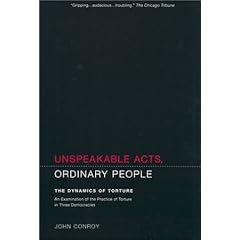
I guess that isn't much of a positive review of a book, and now when I tell you that John Conroy's Unspeakable Acts, Ordinary People: the Dynamics of Torture - an Examination of the Practice of Torture in Three Democracies is an extraordinarily humane, responsible look at torture practices in three so-called first-world nations, it might sound like faint praise. But Conroy's book is powerful, gripping, and haunting, and if you are interested in the way that violence is used to get so-called intelligence or the ways in which violence is justified in the service of humanity, you should definitely give it a look.

28 May 2008

The Apocalypse

I read Philip Ridley's play Mercury Fur today. For fun (ha ha). And I'm wondering. I don't think I much dig visions of the apocalypse.

Maybe I have trouble imagining dystopias. Or maybe I just don't buy them. I believe I had a similar reaction to José Rivera's Marisol (which I think is kinda boring.)

Mercury Fur is a dystopian vision where everyone is young. There is a lone female character (whom the boys all call the "Duchess") and she is their mother, around thirty-eight years old. Everyone else in the play is younger, the oldest being twenty-three and the youngest ten. The sexuality in the play is strange (could it be anything other than strange in a world populated only by young men?) but the play's content is—in a word—horrific. The young men are throwing a party where the young boy will be eviscerated by a paying customer and a meat hook.

The play is good, and I found it emotionally wrenching, but... I don't know why I need to qualify it. The thing is, I loved Children of Men, certainly an apocalyptic vision of the world, but one that seems possible to me. Or maybe it's that Children of Men is a movie, and I can believe it more easily because I can easily see it. For some reason, I find the apocalypse on stage to be something I can't quite embrace fully. I dunno.

P.S. Any ideas what the title Mercury Fur refers to? I can't figure it out. And Google isn't being much help.

09 August 2007

Violence Overload

I know there is too much to read and so much work to be done and all of that. I was talking about just that on this here blog a couple days ago.

And yet. All of these violent plays (Barker—yikes! and Rudkin—unbelievably horrific) and all of this depressing theory (I finished Jordan Schildcrout's dissertation on queer killers) — it's getting to me. I almost long for the hard, firm materiality of history reading. I can, at least, address Brockett and Knox and those guys. There's something to fight with. These unspeakable horrors (and American political realities) leave me feeling rather impotent.
I need some sunshine.

I'm going to read a happy book. I wonder if I have any on my shelves.

20 December 2006

Rope

Has everyone heard of Alfred Hitchcock's 1948 film Rope? It's a milestone for several reasons.
It's the first film Hitch made in color.
It also has (not so?) latent homosexuality as an undertone of the film. Definitely a curiosity in 1948.
It also is a continuously shot movie. Well, to be precise, the movie consists of nine extended shots. They couldn't shoot the entire film without cutting because the cameras couldn't hold enough film to do that back in the forties. The camera, instead, will move close in on the back of one of the actors and then move away and the cuts are hidden (well, they're totally obvious, but still...) while the screen goes black for a second before we move away from the actor's back.

The film stars John Dall (The Corn Is Green) and Farley Granger (Strangers on a Train) as murderers (and lovers?) who conspire to commit the perfect murder and then throw a dinner party. The first guest arrives fifteen minutes later. James Stewart is the one guest at the party who just might be able to solve the murder. It's suspenseful and really intriguing. Farley Granger is pretty near excellent in the picture, the dialogue sparkles and the way the film is shot is so extraordinary that it's worth a rental just for Hitchcock's technique.

27 July 2005

Terrorism

Monday on All Things Considered they had some guy who was the first Muslim ever elected to British Parliament or something. He was on there talking about the difference between the use of terrorism in Iraq and the use of terrorism in the middle of London. Robert Seigel kept trying to get him to define his position... how can terrorism be okay in Iraq (and Israel) but not okay in London? The Muslim Parliament guy kept saying that if civilians died, the people setting off the bombs were terrorists. I am blown away by this.

Can we still be this confused on our definition of "terrorism?" I don't think it's that difficult a concept to grasp. Terrorism is a tactic used by political bodies to enact political change. Terrorist organizations are political groups who have political goals but use military means as their way of achieving them. A terrorist act is a usually violent, almost always spectacular military attack, but for the military action to qualify as "terrorism," the goal of this attack must be "to create terror." Terrorists hope to achieve their goals through fear. Their enemies (usually occupying factions) will ideally become frightened and give in to the terrorists' demands. The IRA used terrorism in Ireland and I always considered it totally justified. They were an occupied nation fighting for their own freedom. I saw Michael Collins. Another great film about (completely justified) terrorism is Gillo Pontecorvo's The Battle of Algiers.

I am not sure what the point of this post is, completely, but listening to this British legislator made me frustrated all over again with the misuse of this word "terror." I don't think terrorism is always bad: when used to fight occupation, it is, often, the only tactic that will get the downtrodden any traction. I had been thinking about this a couple of days and then this morning I read that the U.S. administration is now using different terminology to describe the war in Iraq. It's no longer a global war on terror; it will now be called the struggle against violent extremism. I think the new phrase is infinitely more accurate.

29 June 2005

Yesterday, in the News...

President Bush repeats the old song about "terrorism" and "September 11" and "combating hotbeds of terrorism." A hotbed of terrorism, John Kerry pointed out, that didn't exist before we got to Iraq.
Bush is such a fucking liar. He hoped last night's speech would shore up support for the war: support that is dwindling, even among red states. I can't see how last night's speech gave him any headway, or even a slight boost. If he is going to continue to lie to me, I am going to continue to find it difficult to support his policies. And he continues to link the terrorist attacks on this country on September 11th, 2001 to the terrorists in Iraq. He calls them all "the terrorists," as if we're whittling them down. This is all just bullshit. I mean, he's just lying. Period.

Meanwhile, the Canadian House of Commons passes a bill that gives homosexuals the right to marry: the same exact rights that heterosexual couples have. Canada isn't just the country that belched Céline Dion onto our shores, it's also a country that has respect for equality. Hm.

25 May 2005

Violence, Man.

This evening's plan was to go see Ladies of Lavender, but I realized this was the last week Sin City was playing in my town and if I didn't catch it tonight I was going to be assed-out. So I paid my cheap $6 and saw the Frank Miller/Robert Rodriguez/Quentin Tarantino noir-fest at the Academy theatre down the street. The movie was cute. It has loads of style, not a thing to say in the world, an extremely clever score (by Rodriguez, naturally), some very nice performances--Bruce Willis, Clive Owen, Rodriguez perennial Mickey Rourke, and Rosario Dawson who is fucking hot--but damn this movie is dumb. The Tarantino sequence stands out (not unexpectedly). It's the most hip and the most dangerous from a storytelling point of view. The other stuff is mostly just brutality after brutality with unforgivable acts being punished in kind. It looks fabulous, of course: you could tell that from the trailer--shit, you could tell that from the one-sheets--but it's not really much to get too excited over. It's exciting in parts (I guess) and it has a few nice visuals, but no moments that have anything whatever to do with reality in any way and--worse yet--I never really felt satisfied by the carnage the way I did in Kill Bill, or the way I did with Oldboy or even, say Infernal Affairs or Pulp Fiction.

Enough of that...

I saw the Third Annual Alpha Psi Omega production last night (a tradition Allan (and Marcos) and I started our senior year at CSUP.) Last year was Cloud 9. This year it was Matthew Reidy's Growing Up Johnnie and Stosh. It's a fine choice for a play, and I think it's a very nicely-written piece about Midwest ennui, violence and prejudice (something I know next to nothing about, thankfully.) It has an excellent ending at any rate and a very nice setup. Some stuff is not as tight as I would have liked--one of the young people's dads is far too prominent a character for his own good--but it's an interesting piece. I don't want to review the production here, but I wanted to mention it in case any of you were planning on going. It has one performance left: Saturday at 8:00p in Room 110 at CSUP.
Lots of old-timers were there: Ryan Schauer (who lit our first show), Wahima Lino (who bought my ticket: booyah), Caroline Collins, Christina Russo, and Jensen Kong.